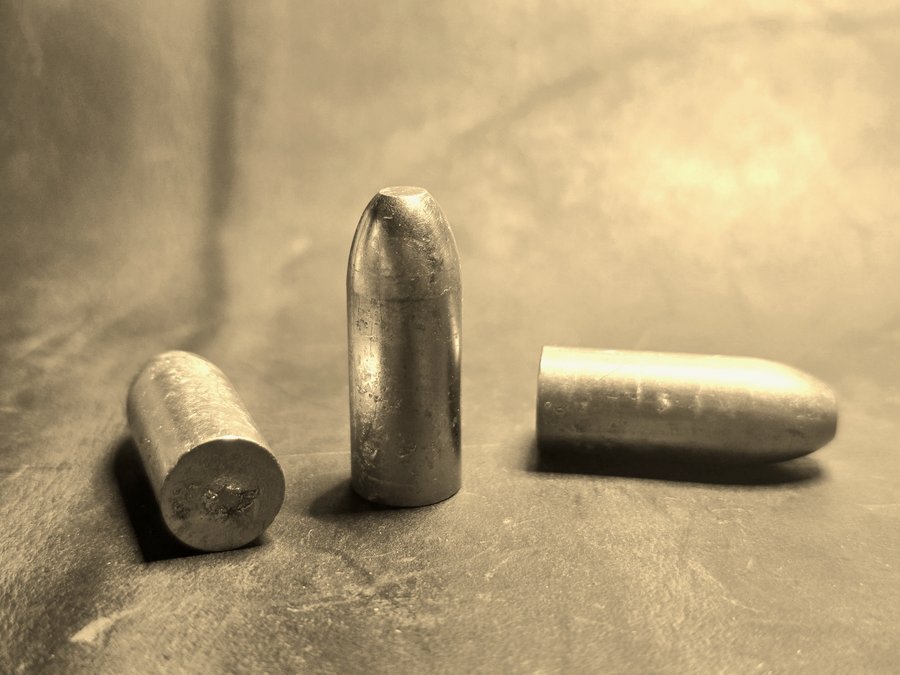
Martini-Henry Bullet, Cast
Historical Background
The Martini-Henry .577/.450 entered British service in 1871 and remained the standard infantry arm through the colonial campaigns of the following two decades, serving at Isandlwana, Rorke's Drift, Tel el-Kebir, and across the North-West Frontier. Its cartridge was among the most thoroughly developed military rounds of the period — a compressed foil case containing a carefully specified paper-patch bullet cast to a standardised lead-tin alloy.
The War Office alloy of 12 parts lead to 1 part tin was not incidental. The tin content lowered the melting point slightly and improved flow into the mould, producing bullets with sharper detail and more consistent weight than pure lead alone. The resulting alloy was also marginally harder, which aided the bullet's performance under the compression of the paper patch and the stresses of firing. The smooth-sided profile, patched to bore diameter, was the British solution to the problem of combining reliable chambering with consistent engagement of the rifling.
Original military bullets were swaged rather than cast, yielding dimensional consistency beyond what casting alone could reliably achieve. For the collector and reenactor assembling period-authentic cartridges, cast bullets to the correct mould geometry and alloy specification represent the closest available approximation of the original.
Materials & Construction
Cast from a 12:1 lead-to-tin alloy matching the War Office specification. Tin is a meaningful material cost relative to pure lead, and its inclusion here is not ornamental — the alloy produces a better cast and a bullet that behaves correctly under the paper patch. Bullets are sold as cast with no post-processing applied.
The X-Ring Services No. 45-505XR is a single-cavity aluminium mould designed specifically for the .577/.450 paper-patch bullet. It produces a smooth-sided cylindrical body at .458″ diameter, intended to be patched to .468″ with two wraps of appropriate paper. X-Ring Services moulds are available from the Martini-Henry Society; the brass cutting template sold alongside this mould is used in the production of the paper patches sold separately on this site.
Packed in a resin-printed protective box of 25. The box holds bullets individually to prevent contact during shipping, protecting the surface condition of the cast body which is important to consistent patch adhesion.
Full Specification
| Cartridge | .577/.450 Martini-Henry |
| Mould | X-Ring Services No. 45-505XR |
| Diameter (as cast) | .458″ |
| Diameter (patched) | .468″ with two wraps |
| Weight | 505 grains |
| Alloy | 12 parts lead, 1 part tin |
| Profile | Smooth-sided, ogival nose |
| Condition | As cast — unpatched, unlubricated |
| Packaging | Resin-printed protective box, 25 bullets |