.36 Calibre Cast Bullet
Historical Background
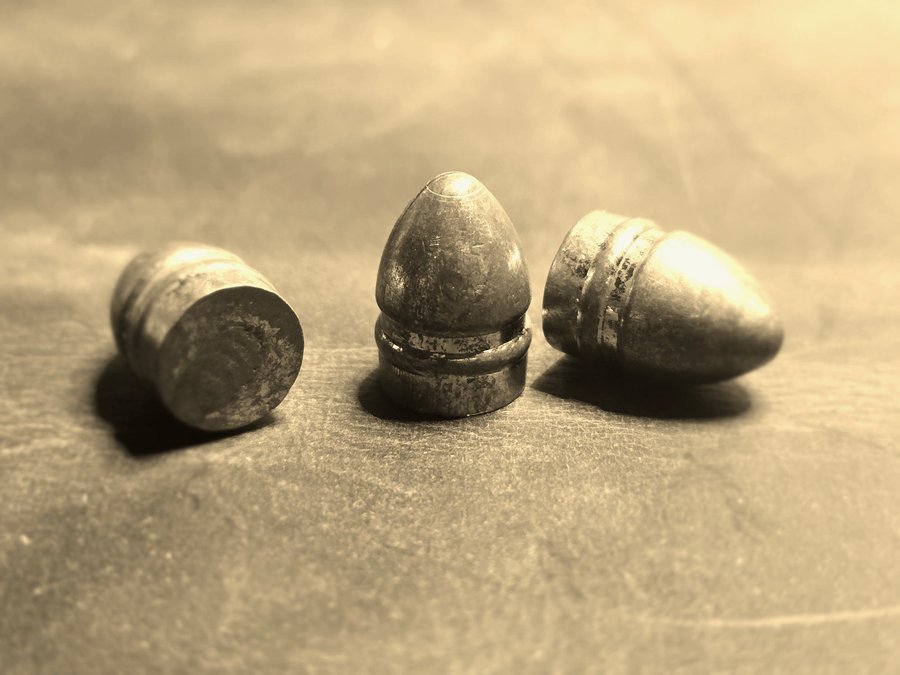
The heel-base bullet produced here follows the pattern introduced by Colt's own cartridge manufacturing operation around 1862, at the height of Civil War demand for the .36 calibre Navy and Belt revolvers. Colt had by that period established a commercial cartridge works producing combustible paper envelope cartridges for the civilian and military markets, and this bullet design was central to that production.
The defining feature of the pattern is its long tapered heel — a reduced-diameter base section smaller than the chamber mouth. This serves two purposes. First, it allows the loaded cartridge to be seated easily into the chamber without resistance, a significant practical advantage in the field. Second, and equally important for the cartridge maker, the heel provides a generous surface area for the attachment of the paper envelope, which is wrapped and secured around it before the powder charge fills the tube above. The geometry of the heel is thus a manufacturing consideration as much as a ballistic one.
The long tapered heel also confers a practical advantage for shooters using modern reproduction revolvers, many of which lack the loading-cutout geometry of the original Colt revolvers. The reduced heel diameter allows the bullet to be seated deeply enough into the chamber mouth that it clears the cylinder and can be rotated under the loading lever without obstruction.
Materials & Construction
These bullets are cast from pure lead in purpose-made moulds cut to period dimensions. No antimony or alloy is used — period revolver cartridges employed pure or near-pure lead, and hardened alloys are neither appropriate nor desirable for paper cartridge use, where the bullet must obturate cleanly at the pressures generated by black powder charges.
Bullets are sold unlubricated. Lubrication practice varied in the period — tallow, beeswax, and various blends were all used — and buyers who intend to assemble their own combustible cartridges will apply lubrication as part of their own process. Those loading with loose powder should apply a suitable period-appropriate lubricant to the bearing surface before chambering. A tallow-beeswax blend in approximately 3:1 ratio by weight is our own standard and performs well.
Specifications
| Pattern | Colt Cartridge Works, c. 1862 |
| Mould | Lee precision — .375 dia. round heel, long taper |
| Intended Arm | Colt Navy (.36 cal.), Colt Belt Revolver (.36 cal.) |
| Nominal Calibre | .36 |
| Diameter — body | .380 in. |
| Weight | 126 grains |
| Nose profile | Round-nosed conical |
| Base profile | Long tapered heel, reduced diameter |
| Material | Pure lead, no alloy |
| Lubrication | None — sold bare |
| Recommended charge | ¾ dram (~20.5 gr.) FFFg — per Colt company advertisement |
| Quantity per order | 50 bullets |