.44 Calibre Cast Bullet
Historical Background
Johnston & Dow was one of the principal suppliers of combustible paper cartridges to the Union Army during the Civil War, producing cartridges for the Colt Army revolver in quantities sufficient to meet the considerable demand generated by the conflict. The firm's .44 calibre conical bullet was among the most widely distributed revolver projectiles of the war, loaded into paper envelope cartridges that allowed rapid reloading under field conditions.
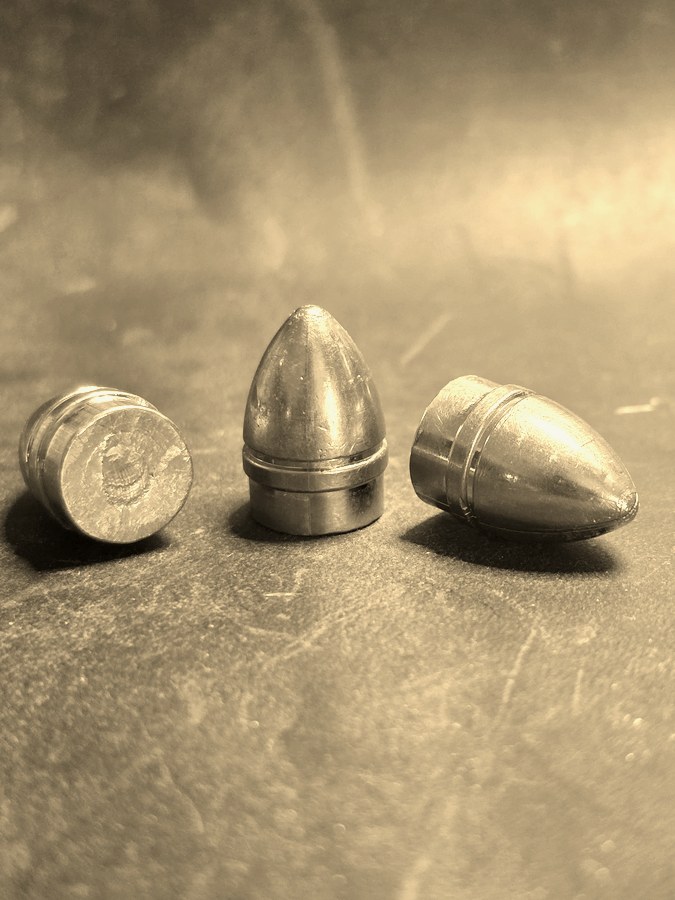
The pattern is a heel-base conical with a pronounced cylindrical body, a single grease groove above the heel, and a drive band of .460 inch diameter that swages slightly on seating to provide both a gas seal and secure engagement with the rifling. The diameter above the groove — .451 inch — is consistent with the chamber mouth dimensions of the Colt Army and Remington New Model Army revolvers for which these cartridges were produced. The heel itself is reduced in diameter to seat easily in the paper envelope tube, the geometry serving the same manufacturing function as the heel on the .36 Colt Cartridge Works pattern.
These bullets are cast on a mould produced by Eras Gone Bullet Molds, machined to the dimensions of an original Civil War specimen. The mould was developed from direct measurement of period examples, making it among the most dimensionally faithful reproductions available to the collector and cartridge maker.
Compatible Arms
The Johnston & Dow conical is dimensioned for the Colt Model 1860 Army, Remington New Model Army, and other .44 calibre cap-and-ball revolvers of the period with cylinder chambers of approximately .451 inch. The .460 inch drive band seats under the loading lever with modest effort in pure lead, providing the gas seal essential for reliable ignition in a combustible cartridge.
Materials & Construction
Cast from pure lead with no antimony or hardening alloy. Period revolver cartridges used pure or near-pure lead specifically because the soft material obturates cleanly at black powder pressures, engaging the rifling without the resistance that a hardened alloy would create and providing the gas seal necessary for consistent ignition of the combustible cartridge envelope.
Sold unlubricated. For combustible cartridge assembly, lubrication is applied to the grease groove as part of the assembly process before the paper envelope is attached. For loose powder loading, a suitable period-appropriate lubricant — tallow-beeswax in approximately 3:1 ratio is our standard — should be applied to the grease groove before seating.
Each order of 50 is shipped in a purpose-made resin-printed container that holds bullets individually, preventing contact between the precision heel and nose surfaces during transit. The drive band and heel dimensions are critical to proper seating and gas seal; the container ensures they arrive undamaged.
Specifications
| Pattern | Johnston & Dow, c. 1861–1865 |
| Mould | Eras Gone Bullet Molds — machined from original specimen dimensions |
| Intended Arm | Colt Model 1860 Army (.44 cal.), Remington New Model Army (.44 cal.) |
| Nominal Calibre | .44 |
| Diameter — drive band | .460 in. |
| Diameter — above groove | .451 in. |
| Heel diameter | .428 in. |
| Overall length | .686 in. |
| Heel length | .157 in. |
| Bullet weight | 217 grains |
| Nose profile | Ogival, blunt-nosed |
| Base profile | Heel-base with single grease groove |
| Material | Pure lead, no alloy |
| Lubrication | None — sold bare |
| Quantity per order | 50 bullets |
| Packaging | Resin-printed container — bullets seated individually to prevent contact between heels and noses during transit |