Chassepot Needle-Fire Cartridge
Historical Background
The Fusil Chassepot Modèle 1866 was the principal infantry arm of the French Army from its adoption through the Franco-Prussian War of 1870–71, and represented a significant advance over the contemporary Dreyse needle gun it was designed to surpass. Where the Dreyse placed its primer at the base of the powder charge — requiring the needle to travel the full length of the cartridge to reach it — the Chassepot positioned its primer immediately behind the bullet at the forward end of the charge. This shortened the needle's travel, reduced breakage, and produced more reliable ignition.
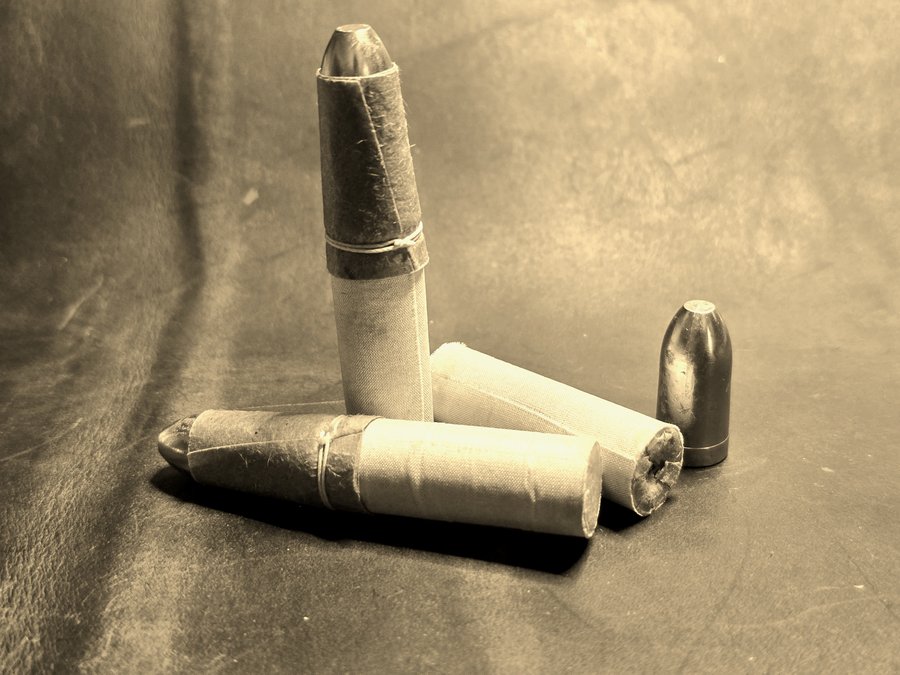
The cartridge itself is among the most mechanically sophisticated of the paper cartridge era. A paper tube body, reinforced with a silk gauze wrap, carries the propellant charge, sealed at the base by a paper disc and crimped tube. At the forward end, a rubber obturator disc and internal primer assembly is the Chassepot's elegant solution to the gas-sealing problem that plagued all needle-fire designs. A paper cone and patch assembly joins bullet to charge body by ligature, the whole being a self-contained unit that chambers, fires, and leaves no residual case to extract.
Period cartridges were packaged in pasteboard boxes of nine, a quantity that reflects the standard French infantry load allocation of the period. Surviving examples of original Chassepot ammunition are genuinely scarce, and functional reproductions are, to our knowledge, not available from any other commercial source.
Materials & Construction
Each cartridge is assembled by hand from individually produced components. The powder charge tube is rolled from kraft paper — the original material was almost certainly a period rag paper no longer commercially available; kraft is used as the closest functional substitute. The tube is sealed at the base with a glued paper disc, and a silk gauze wrap is then applied over the exterior with its seam opposite the paper seam, providing the reinforcement required to withstand the compression of the powder charge during filling. The silk gauze is visible on the lower half of the finished cartridge as the external reinforcement of the powder charge body.
Assembly proceeds by inserting the resin-printed obturator disc — carrying the internal needle-fire primer and its rubber needle seal — into the forward end of the tube. The tube is then filled with a measured black powder charge delivered through a drop tube, after which the charge is vibrated and compressed to ensure consistent density. A cardstock washer is seated over the charge and the excess tube crimped to seal the base. The paper cone and patch assembly, formed on a purpose-made mandrel to Modèle 1866 dimensions, is then joined to the powder body by linen ligature wound and tied by hand.
The bullet is cast from pure lead using an Accurate Molds die cut to Chassepot dimensions, with a hollow base for obturation and a flat nose — a consequence of the CNC mould manufacturing process, which does not readily produce the domed nose of the original swaged bullet. The flat nose has no effect on function. Bullets are cast in large batches; finished cartridges are assembled in lots of twenty from pre-produced components.
Specifications
| Arm | Fusil Chassepot Modèle 1866 |
| Bore Diameter | 11mm |
| Bullet Profile | Flat-nose, hollow base |
| Bullet Material | Pure cast lead |
| Bullet Pattern | Accurate Molds Chassepot die |
| Powder Tube | Rolled kraft paper (orig.: period rag paper) |
| Tube Reinforcement | Silk gauze wrap, seam opposite paper seam |
| Tube Seal — Base | Glued paper disc, crimped tube over cardstock washer |
| Propellant | Black powder — 5.6g (86.4 grains) |
| Bullet Weight | 25g (386 grains) |
| Primer | Internal needle-fire, forward-positioned |
| Primer Retainer | Resin-printed disc (orig.: moulded card) |
| Obturator | Rubber disc, recess-seated |
| Joint | Linen ligature, hand-tied |
| Box Quantity | 9 cartridges — period standard packaging |
| Trial Lot | 3 cartridges in resin protective case |
| Price — Box of Nine | $90.00 |
| Price — Trial Lot | $30.00 |