Chassepot Powder Tubes
Description
The powder case is the most labor-intensive component of the Chassepot Modèle 1866 cartridge. The Manuel de pyrotechnie treats its manufacture as a multi-stage operation involving separate workers for rolling, priming, gauze application, filling, tamping, and closing — requiring, at full production scale, a workforce of 88 men to yield 10,000 cartridges per twelve-hour day. Each tube sold here represents that same sequence of operations carried out individually.
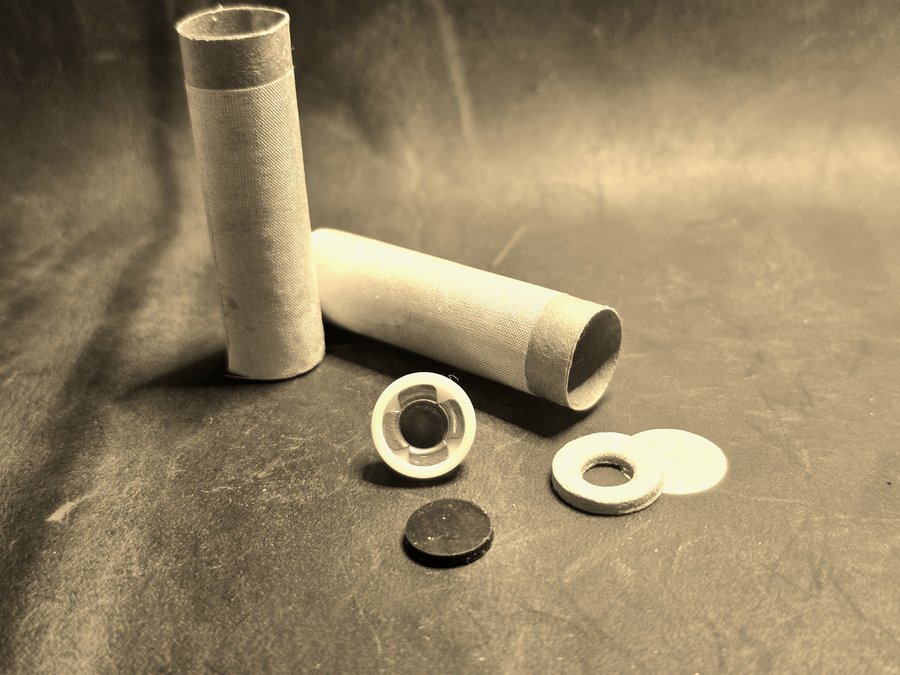
The tube body is a paper cylinder rolled on a 13 mm bronze mandrel from an 80×48 mm rectangle, seam-glued with casein glue and reinforced with a square of silk gauze applied flush with the primed base. The gauze wrap — a defining feature of the Modèle 1866 case — provides the structural integrity the paper alone cannot, and is visible in the photograph as the woven grey layer over the kraft paper body.
The primer assembly departs from the original in one respect: where the Manuel specifies a stamped cardboard collar to center the capsule, these tubes use a resin-printed base disc that positions the primer with greater precision and repeatability than hand-stamped cardboard allows. The percussion capsule is seated in the disc, the paper star folded down and glued, and the rubber washer secured at the base to seal the mechanism against fouling — exactly as specified. A pierced cardboard retaining disc is fitted over the open end of the charged tube after filling.
Tubes are sold primed and sealed but unfilled. The buyer adds the powder charge, tamps, inserts the retaining disc, and closes the tube by twisting and tying — or by any method suited to their assembly practice.
Filling & Closing
The Manuel specifies a powder charge of 5.50 grams of Powder B (the French service propellant of the period), introduced by funnel without tamping and then leveled, after which a pierced cardboard disc is inserted and the powder tamped firmly with a copper tamper. The tube is then closed by twisting the excess paper, tying with flat pliers, cutting the twisted end 2 mm below the cardboard disc, and pushing the stub into the hole in the disc with the nipple of the scissors.
For period-correct shooting with black powder, substitute an equivalent volume charge of FFg or FFFg. The retaining disc supplied with each tube is pierced to the specified 6 mm center hole; the twisted paper closure procedure is unchanged.
Full Specification
| Arm | Fusil Chassepot Modèle 1866 |
| Paper Rectangle | 80×48 mm |
| Mandrel Diameter | 13 mm |
| Tube Material | Kraft paper, casein-glued seam |
| Reinforcement | Silk gauze square, 43 mm side, casein-glued |
| Primer Alignment | Resin-printed base disc (replaces stamped cardboard collar) |
| Primer | Percussion capsule, centered in base disc, paper star folded and glued |
| Base Seal | Rubber washer, 8 mm diameter × 1.2 mm |
| Retaining Disc | Cardboard, 13 mm OD, 6 mm center hole, 1.7 mm thick |
| Primed Case Height | 42.7 mm including disc |
| Condition | Primed, sealed — powder charge not included |
| Specified Charge | 5.50 g Powder B (original); FFg/FFFg black powder equivalent |
| Dimensional Source | Manuel de pyrotechnie à l'usage de la marine, Ch. VI |
| Quantity | 25 tubes |