Chassepot Paper Cone
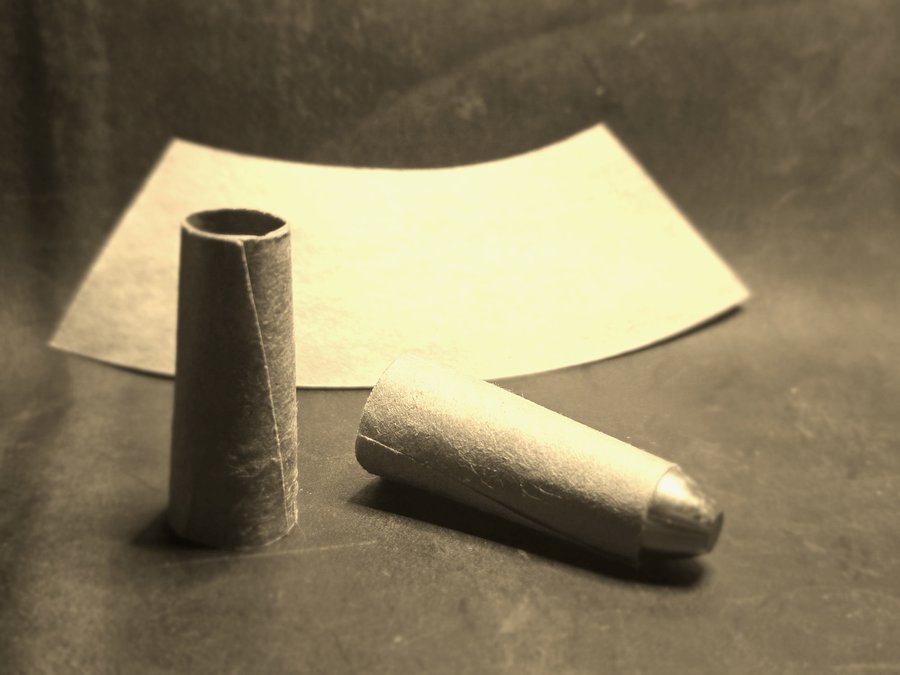
Description
In the Chassepot Modèle 1866 cartridge, the bullet is not housed directly in the powder case. It rides in a paper cone — a curvilinear trapezoid blank wrapped around the bullet's base and skirt, joined to the powder case below by ligature. The Manuel de pyrotechnie à l'usage de la marine designates this component the cône and treats its manufacture as a distinct operation from that of the powder case, requiring its own tooling: a bronze truncated-cone rolling mandrel, a notched sheet-iron gluing template, a boxwood bullet-seating mandrel, and stepped scissors for trimming the finished cone to height.
Each cone offered here is cut to the curvilinear trapezoid geometry given in the Manuel — large base chord 105 mm, small base chord 66 mm, with the corresponding arc radii — rolled on a bronze truncated-cone mandrel, and seam-glued with casein glue following the original method. The cone is then trimmed to the correct exposed-paper height using stepped scissors placed against the seated bullet, exactly as described in the Manuel. Excess paper at the base is trimmed away as well, so that assemblers working by ligature have no material to remove if the powder case is correctly built to dimension.
Bullets are not included. The cone is sold as a finished paper form ready for the buyer to seat a bullet of correct diameter, grease the exposed paper, and proceed to ligature against the powder case.
Assembly Notes
Seat the bullet ogival end forward into the cone using a truncated-cone mandrel tapped firmly against a block, so that the bullet is fully and squarely seated with its rear belt at the base of the cone. Grease the exposed paper from the bullet nose to within a few millimetres of the ligature point — the Manuel specifies a mixture of four parts tallow to one part yellow wax applied with a flat brush. The base of the finished cartridge receives a separate coat of virgin wax applied to the powder case before assembly.
To complete the cartridge, insert the powder case into the open base of the cone until it contacts the bullet, verify overall length against a caliber gauge (68.5 mm maximum, 67.5 mm minimum per specification), crimp with a lever crimper, then tie the ligature with No. 30 thread using an artilleryman's knot finished with a half-knot seated in the groove of the cartridge.
Full Specification
| Arm | Fusil Chassepot Modèle 1866 |
| Blank Form | Curvilinear trapezoid |
| Large Base Chord | 105 mm |
| Large Base Radius | 121 mm |
| Small Base Chord | 66 mm |
| Small Base Radius | 86 mm |
| Material | Kraft paper, casein-glued seam |
| Mandrel | Bronze truncated-cone, per original specification |
| Condition | Rolled, seam sealed, height trimmed, base trimmed — bullet not included |
| Compatible Bullet | Accurate Molds No. 46-365C |
| Dimensional Source | Manuel de pyrotechnie à l'usage de la marine, Ch. VI |
| Quantity | 25 cones |