Formed Combustible Envelope
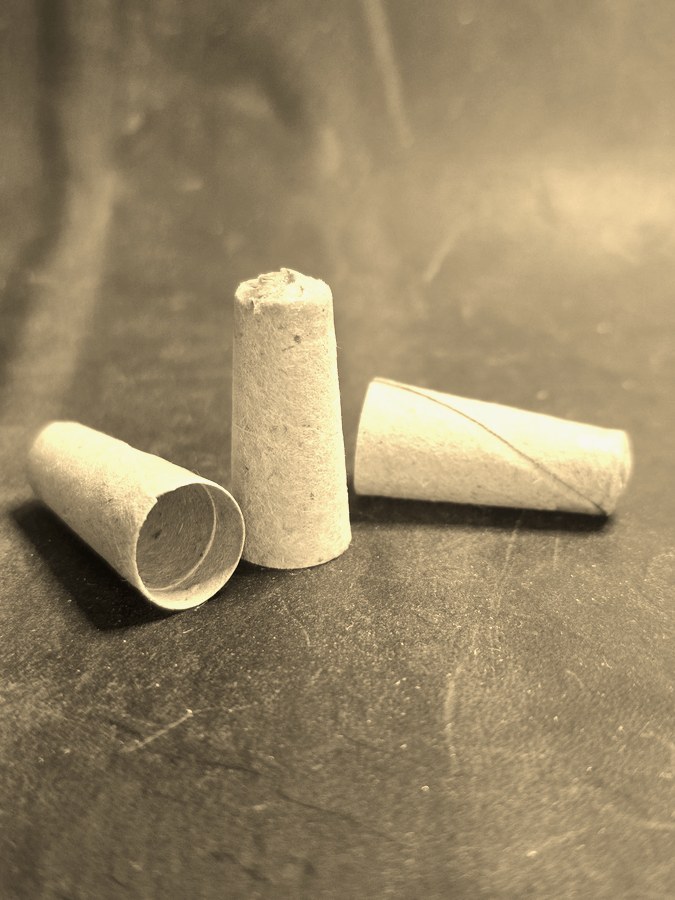
Description & Use
These pre-formed combustible envelopes eliminate the most demanding step in paper cartridge assembly. Each envelope is hand-rolled to original service cartridge dimensions on a period-appropriate mandrel, sealed along the seam with collodion adhesive, and waterproofed. The buyer need only measure a powder charge, pour it in, apply a small amount of collodion or sodium silicate to the bullet heel, and seat the bullet. The result is a complete, historically correct combustible cartridge ready to load into the cylinder.
The paper is nitrated hemp at .005 inch thickness. Hemp at this gauge forms cleanly around the larger .44 mandrel, seats without resistance in properly dimensioned revolvers, and provides slightly more structural rigidity than thinner papers — an advantage in the longer, heavier .44 envelope which must support a 217-grain conical bullet during handling and loading. The collodion sealant ensures the envelope holds its form and resists incidental moisture.
Compatibility — Modern Replicas
These envelopes are formed to original service cartridge dimensions. Original Colt Army revolvers and Colt second generation production accept them without modification. However, most current Italian-made replicas — including Uberti and Pietta — were manufactured to slightly different dimensions in the loading port area, reflecting a production geometry optimised for round ball loading rather than paper cartridges. These replicas require minor modification to the loading port contour before combustible envelope cartridges will seat cleanly.
Materials & Construction
Paper is 100% hemp fibre, handmade, nitrated by hot saturated potassium nitrate solution — the same material sold separately as nitrated hemp paper sheet stock. At .005 inch thickness this hemp paper provides the right balance of formability and structural integrity for the larger .44 calibre envelope.
Seams are sealed with collodion — nitrocellulose in solvent solution, the period-correct adhesive used by commercial cartridge makers from the 1860s onward. Collodion dries to a thin, flexible, fully combustible film. The exterior is given a light waterproofing coat of the same material. No non-combustible adhesives or waxes are used at any stage.
The collodion overcoat is not merely a sealant — it materially improves combustion performance. Untreated paper leaves significant fibrous ash and risks smoldering fragments in the chamber between loads. Plain nitrated paper burns more completely but the rate and completeness of combustion depend on the KNO₃ treatment alone. The collodion overcoat adds a nitrocellulose film to an already nitrated substrate, producing near-instantaneous, near-complete combustion with minimal fine residue. In practical terms this means no smoldering ember risk between loads and negligible chamber fouling from the cartridge body itself — a meaningful advantage for the shooter loading multiple consecutive cylinders.
Specifications
| Calibre | .44 — Colt Model 1860 Army, Remington New Model Army |
| Pattern | Original service cartridge dimensions |
| Paper | 100% hemp fibre, handmade, nitrated |
| Thickness | .005 in. |
| Nitration | Hot saturated potassium nitrate solution |
| Seam adhesive | Collodion (nitrocellulose in solvent) — fully combustible |
| Waterproofing | Collodion overcoat — fully combustible |
| Supplied unfilled | Powder and bullet not included |
| Compatible arms | Original Colt Army; Colt 2nd generation; Remington New Model Army; modified replicas |
| Quantity | 12 per order |
| Packaging | Protective tube, padded shipping envelope |
| Propellant | Black powder only — FFg or FFFg |